I want to do the experiment like you did with aluminum balls.
It made sparks when you hit the balls together. It was short but strong.
I heard Mr. Paul's class made a icecream. I want to do that too.
I want to do something big! hahahaha
ex) black snakes or glow worms
colored fire spray bottle
fake snow
green fire
ice cream in a baggie
colored smoke bomb
glow in a dark slime
making glass
Friday, April 16, 2010

Thursday, April 1, 2010
Gases
STP tells us that 1 atmosphere is 273K. When we do the problems, we have to change the variables of temperture to Kelvin.
For equation PV=nRT, P is pressure(atm, kPa), V is volume(L), n is number of moles(mol), T is temperature(K) and R is a gas law constant. R is always constant and it has value of .0821(L atm)/(K mol).
The important thing that we hace to remember is that volume of 1mol He at stp is 22.4L.
I also learned that higher attitudes have less air pressure. And at a given T, lightest molecules move fastest and heaviest molecules move slowest. 

Charles' Law abd Gay-Lussac's Law tell us that they are both directly proportional.
Equations for both Laws are V=kT and P-kT.
The combined gas law is P1V1/T1=P2V2/T2. They also have to use temperatures as in Kelvin, too. To change the Celcius to K, you just have to add 273 to the Celcius temperature and that will make you to have Kelvin.
 too. To change the Celcius to K, you just have to add 273 to the Celcius temperature and that will make you to have Kelvin.
Friday, March 26, 2010
David Webb and Vacuums

We had special geuest speaker. David Webb showed us many experiments with Vacuums.
First, he showed how the pressure helped people in the old times. He said it was used since a really long time. People use to get a water from a Nile River to upper land. It was pretty interesting that they knew the pressure.
Vacuum had plastic case above and when vacuum started to work, vacuum made pressure lower. when the pressure got lower, the objects went bigger.
There was balloon experiment. He placed the balloon with air in it. When the pressure got lower, the balloon got bigger and finally popped. When they placed a marshmallow, it became bigger. He stopped the vaccum and reput the air in it. I thought the marshmallow will gonna become normal as before without thinking. But marshmallow was flatter than before and it was hard to chew. 

He showed us experiment with leather and object that looked like metal which was much more heavier thatn leather. When he placed both objects and made them fall, they fell at the same time.
Friday, March 19, 2010
Gases

There are three state of matter, solid, liquid, and gas.
And we are learning about gas now.
Gases may be harmful but it is also useful.
Gases are bouncing each other like billiard balls. They always move and moving molecules have kinetic energy.

Evangelista Torricelli developed BAROMETER in 1643 which measures pressure of air. It contains column of mercury. He found out that s standard atom ha 760 mm Hg.
We had experiments about pressure. When we put more pressure in the water bottle, the eyedropper inside the bottle went down and it showed how divers dive in the ocean. And the other experiment was that when we put more pressure in the bottle which had nothing but small balloon, the balloon got smaller and flatter.
Thursday, March 11, 2010
Equilibrium

Chemical Euqilibrium is dynamic, reversible, and have forward rate and no change in concentrations.
Factors that affect reaction rates are temperature, concentration, particle size and catalyst. Euilibria resist change according to the Le Chatelier's principle.
When you increase the temperature and pressure, you'll have more products. But if you decrese them, you will have less. When heat is a product, it is exothermic reaction. And when heat is a reactant, it's endothermic. 

Sunday, March 7, 2010
thermochemistry II

We had a several experiments which were related to thermochemisty.
We boiled the ice cube and change the state of matter. We kept watch the temperature of the substance until it disappered into gas. It increased the temperature when they don't change the matter but it stayed constant when they changed the state of matter.
We also had elephant toothpaste experiment. I really wanted to see this since I saw the video. It was really cool. It just turned yellow and popped up with high temperature. 
We also did alot of thermochemistry problems. It was pretty difficult to find all the temperature and add all up when there are cold and hot water which become solid to liquid to gas. There are many formulas you can use while you solve them, like latent heat of vapor and fusion of water. Latent Heat of Fusion of Water is 80cal/g and Latent Heat of Vaporization is 540 cal/g.
Thermochemistry
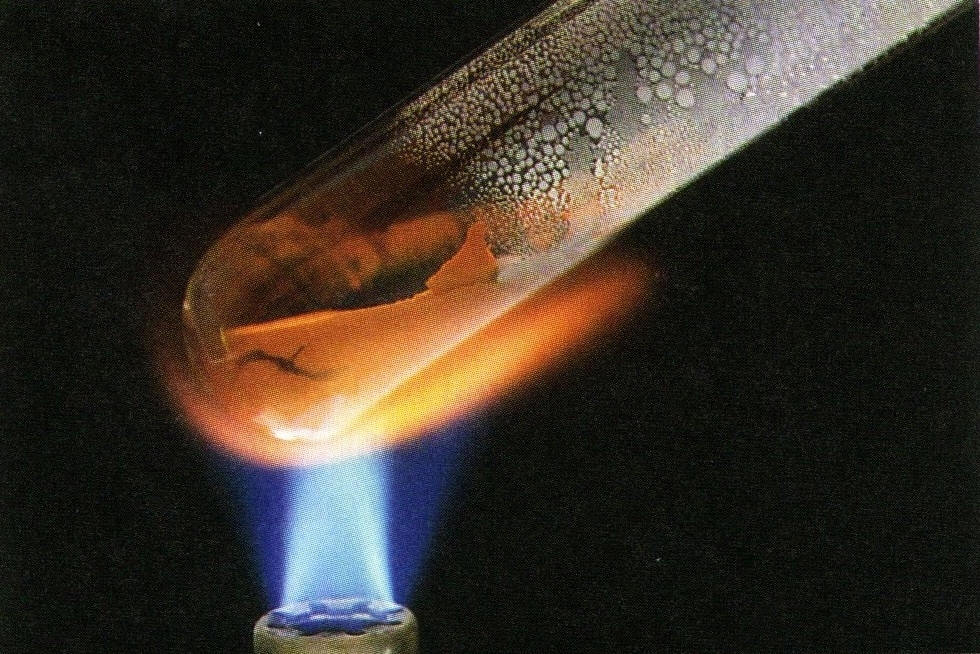
Thermochemistry is the chemistry of energy.
For exothermic reaction, delta H is negative and for endothermic reactions, delta H is positive.
Equation is Q=MC delta T.
Q represents energy, M represents mass, C represents heat capacity and delta represents change in temprerature.
Heat capacity is the amount of energy required to raise the temperature of 1g of X by 1 degree C. And delta T is final temperature minus initial temperature.
1cal is about 4.184 Joule and it is from James Prescott Joule who found this unit.


Subscribe to:
Posts (Atom)